

WOL in the Library
I’m often surprised by where WOL is used. This time, it’s in a new article published by Hamburg University Press about Working Out Loud in libraries.
Here’s an excerpt from their conclusion:
"The lack of social interaction and opportunities for exchange, which employees often complain about, can be addressed through the WOL format (see Fühles-Ubach et al. 2022: 178).
What matters most is that Working Out Loud, as a method, can help employees and the organization move forward by building and strengthening relationships, fostering trust and self-efficacy, and practicing and acquiring new knowledge and skills. This fosters a growth mindset among employees and thus lays the foundation for innovative and creative work cultures within organizations. And besides, it’s a lot of fun!"
I included the abstracts below in German & English as well as the full PDF.
"The article concludes with a plea for WOL to be given greater consideration as a complementary format in the field of continuing education and training in libraries."
I couldn’t agree more. Who knows where WOL will appear next?
***
Working Out Loud in der Bibliothek
Vorstellung der Methode und Erfahrungsbericht
Zusammenfassung
Working Out Loud (WOL) nach John Stepper ist ein strukturiertes 12-Wochen-Peer-Learning-Programm. Der Beitrag schildert die wesentlichen Elemente der Methode. Der Fokus der Darstellung liegt dabei auf den Mehrwerten, die WOL sowohl für den Einzelnen als auch die Organisation haben kann. Drei kurze Erfahrungsberichte zur Durchführung eines Working-Out-Loud-Zirkels an der Staats- und Universitätsbibliothek in Göttingen runden die Darstellung ab. Zum Abschluss erfolgt ein Plädoyer dafür, WOL zukünftig stärker als komplementäres Format im Bereich der Fort- und Weiterbildung in Bibliotheken einzusetzen.
(PDF) Working Out Loud in der Bibliothek: Vorstellung der Methode und Erfahrungsbericht.
Workin Out Loud in the Library
Method and Experience Report
Abstract
Working Out Loud (WOL), according to John Stepper, is a structured 12-week peer learning programme. This article describes the key elements of the method. The focus is on the added value that WOL can bring to both individuals and organisations. Three short reports on the implementation of a Working Out Loud circle at the State and University Library in Göttingen complete the overview. The article concludes with a plea for WOL to be given greater consideration as a complementary format in the field of continuing education and training in libraries.
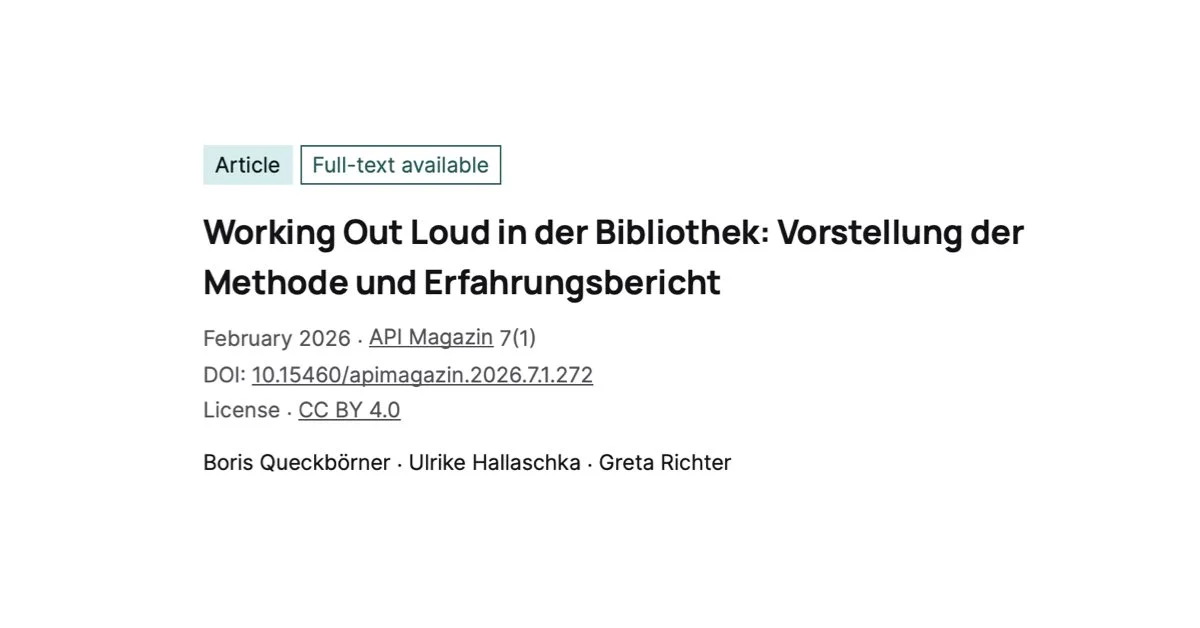
Click on the image to view the full article as a PDF.


