
Book recommendation: The Social Paradox
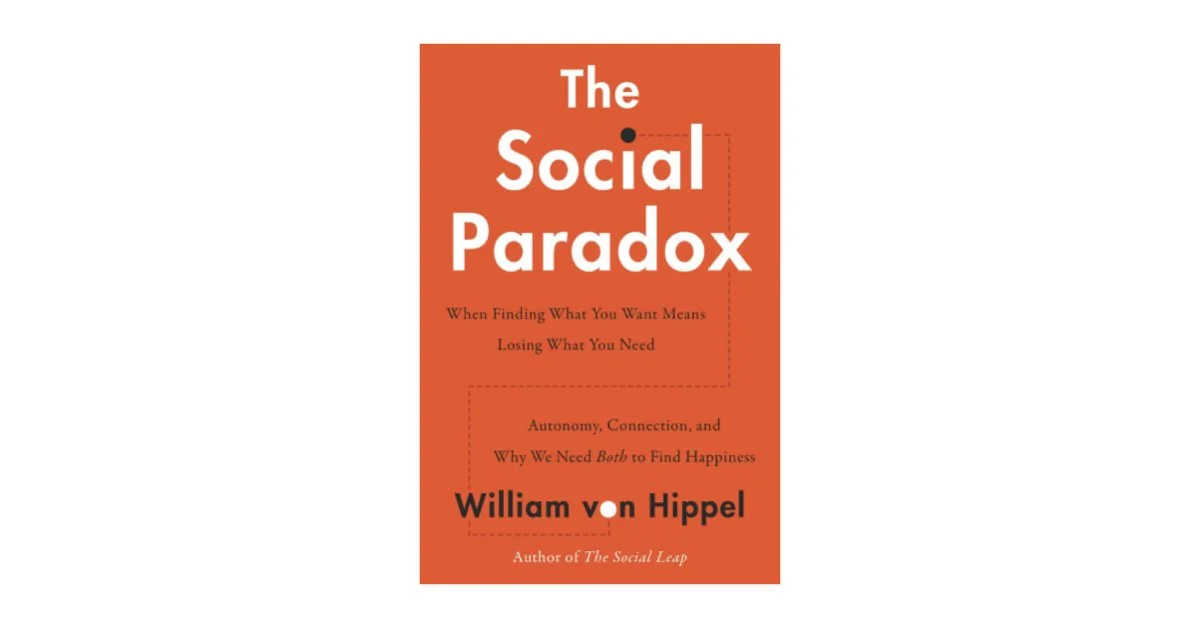
I read William von Hippel’s latest book, The Social Paradox, last month and I’m still thinking about it.
It offers a compelling way to think about two basic human needs: autonomy and connection.
Based on Self-Determination Theory, I had always thought of these needs as complementary. But von Hippel argues they’re in conflict, requiring trade-offs as we choose one over the other in different situations.
Our ancestors faced the same tension, but in a very different context:
“Throughout our evolutionary history, connection was of paramount importance. We needed to form tight connections to survive…Connection was an obvious necessity. But autonomy was a luxury.”
Over time, our world has shifted dramatically. We now have far more opportunities for autonomy. But von Hippel argues we’re not well adapted to that abundance:
“In our modern world, opportunities for autonomy are like salt, fat, and sugar—they’re everywhere…our tendency to pick autonomy whenever we’re given a genuine choice has become a form of miswanting.” (I love that word choice. :-))
“Just because our modern world allows us to live a certain way doesn’t mean that it makes us happy. We may get what we want when we prioritize autonomy, but we don’t get what we need.” (italics in original)
He then uses this social paradox as a lens to explore everything from politics and culture to relationships and wellbeing.
This lens also gave me a new way to view Working Out Loud®. In a WOL Circle, each person works toward their own goal. That’s autonomy. But they do it in a small group, with support, encouragement, and shared learning. That’s connection.
Maybe that combination is part of what makes peer learning so powerful.
Ever since Bowling Alone, the shift to greater autonomy and less connection has been evident—and accelerating.
What if Circles are one way for people to experience a healthier balance?